Quick answer
Mitacs Accelerate funds research internships in which a university student or postdoctoral fellow works on a project with a partner organization, co-supervised by a university faculty member. Not-for-profit corporations are eligible partners. The standard partner contribution starts at $7,500 per four- or six-month internship, which Mitacs turns into a $15,000 research award.
Since September 2026, nonprofit partners, unlike businesses, may use government-sourced funds for their contribution, as long as those funds aren’t already being used as matching for a federal program. A strong project needs a genuine research question, an academic supervisor whose expertise fits, and a plan for how your organization will use the results.
What Mitacs Accelerate is
Mitacs is a national not-for-profit organization that funds research collaborations between Canadian academic institutions and partner organizations. Its main program, Accelerate, funds research internships delivered in four- or six-month units. Longer projects combine several units, and a project can involve more than one intern.
- The intern is a registered student, most often a graduate student, or a postdoctoral fellow at a Canadian academic institution.
- The academic supervisor is a faculty member eligible to hold federal research council funding, who supervises the research.
- The partner organization (your nonprofit) co-develops the project, provides access and context, and co-supervises.
Funding flows to the university rather than through your payroll, and the intern is paid through their institution. Applications go through a research review rather than a competition.
Who can be a partner
Mitacs lists five kinds of eligible partner organizations in Canada: for-profit corporations, not-for-profit corporations, hospitals, municipalities and Indigenous governments. Most charities are incorporated not-for-profits, but Mitacs advises nonprofit, hospital and municipal partners to confirm their eligibility with a Mitacs representative before developing a proposal.
Mitacs also runs an Indigenous Pathways initiative. Among other routes, a not-for-profit qualifies if at least half of its board self-identify as First Nations, Métis or Inuit, or if the participating student is Indigenous.
What it costs
Under Mitacs’s standard funding model, the partner contribution starts at $7,500 per four- or six-month internship, which results in a $15,000 research award. Postdoctoral internships are larger awards with a larger partner share; confirm current amounts with Mitacs, and note that sales tax may apply to the contribution.
- The contribution is paid to Mitacs, not the university, and internships can’t start until it has been received and the research review approved.
- Budget your own time. Co-supervision, meetings, data access and review of findings are real in-kind costs.
- Plan the start. Projects should begin within a year of research approval.
The 2026 rule change that favours nonprofits
In 2026 Mitacs changed how it checks where partner funds come from. According to its August 2026 update for research administrators:
- For-profit partners must contribute private-sector funds, not money from federal, provincial or municipal government grants or contributions.
- Not-for-profit organizations, hospitals, municipalities and Indigenous governments are encouraged, but not required, to contribute private-sector funds. Their projects remain eligible even if the contribution comes from government funding.
- For every partner, funds already being used to meet a matching requirement for a federal program make the contribution ineligible, unless the application goes through an established joint process with another funder.
For nonprofits, that is good news: an operating grant or a provincial program grant can, in principle, fund your contribution. Just don’t count the same dollars as a match somewhere else.
What makes a good Mitacs project for a nonprofit
Mitacs funds research, not staffing. The strongest nonprofit projects share a few features:
- A genuine research question your organization needs answered, and that also interests an academic researcher.
- Data or access you can provide, such as program data, participants, partners or settings, with privacy and ethics arrangements to match.
- Results you will actually use, in a program decision, a funding application, a policy brief or a strategic plan.
- Capacity to co-supervise: a staff member with time to meet regularly with the intern.
Typical examples include an outcome study of an existing program, analysis of administrative or service data, mapping who a program reaches, developing and testing a measurement tool, or an evidence review that informs practice.
How to get started
- Write down the question, and what you will do with the answer.
- Find an academic supervisor. Start with researchers you already know, your local university’s research or partnerships office, or a Mitacs advisor.
- Talk to Mitacs early to confirm eligibility, funding and which application platform to use.
- Co-develop the proposal with the supervisor and intern: objectives, methods, timeline, deliverables and roles.
- Agree on data, intellectual property and publication with the university before work starts.
- Arrange ethics review where the research involves people, and allow time for it.
- Pay your contribution once the research review is approved, then start.
Timelines vary. Mitacs reported that one recent application through its new application portal went from submission to award payment in 36 days; plan for longer if ethics review or university agreements are involved.
Common pitfalls
- Treating the intern as staff. If the work is routine operations rather than research, it doesn’t fit the program and won’t serve the student.
- A question that is too vague to research within the internship, or too narrow to interest a supervisor.
- No access to the data or people the research depends on, discovered after the project starts.
- Unclear ownership of data and results, which is far easier to agree before work begins.
- Ignoring the academic calendar. Students have courses, exams and thesis deadlines.
- Using matched federal funds for your contribution.
Designing a larger research program
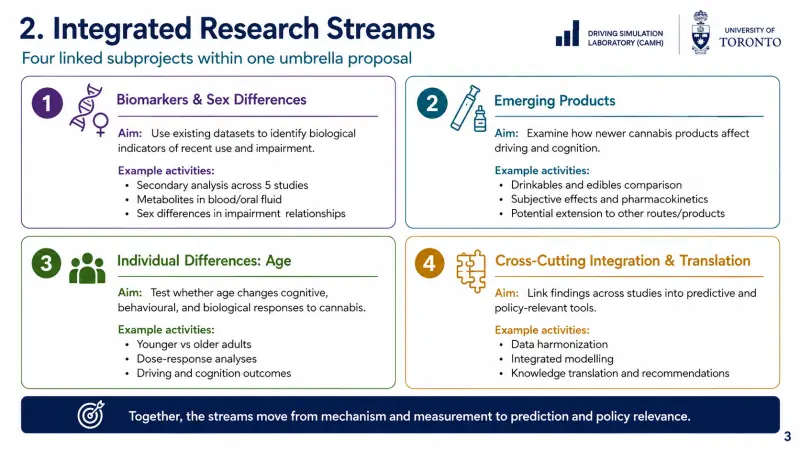
Mitacs can also support multi-year programs with several interns. For CAMH’s Driving Simulation Laboratory, we designed a multi-year research program for a Mitacs Accelerate application, structuring four research streams with six to nine planned trainee positions, a linked training plan and a knowledge translation pathway.
Mitacs is one of several routes into research partnerships. Organizations working with researchers on larger questions should also look at the federal research councils’ partnership funding; see what CIHR and SSHRC reviewers score.
Common questions
Can a registered charity be a Mitacs partner?
Mitacs lists not-for-profit corporations as eligible partners, and most registered charities are incorporated not-for-profits. Mitacs asks nonprofit partners to confirm eligibility with a Mitacs representative, so check before investing time in a proposal.
Can we use a government grant to pay our contribution?
Under the rules in place since September 2026, nonprofit partners may contribute government-sourced funds. The exception, for all partners, is funds already being used to meet a matching requirement for a federal program.
Is the intern our employee?
No. The research award flows from Mitacs to the university, and the intern is paid through their academic institution. Your organization co-supervises the research but doesn’t employ the intern.
How long does it take to get approved?
It varies with the project and the platform. Mitacs has reported a recent application going from submission to payment in 36 days, but ethics review and university agreements can add time. Projects should start within a year of research approval.
Who owns the research results?
That is agreed among your organization, the university and the intern, usually in a research agreement. Settle data use, intellectual property and publication before the work starts.
Do we need a university connection before applying?
It helps, but it isn’t essential. University research and partnership offices and Mitacs advisors can help you find a supervisor whose expertise fits your question.
The short answer
Nonprofits can host student and postdoctoral researchers through Mitacs Accelerate, contributing from $7,500 per internship unit for a $15,000 research award. Since September 2026, nonprofit partners may use government-sourced funds for their contribution, except funds already used as federal matching. Bring a real research question, a willing academic supervisor and a plan to use the results.
Geo-Lens is a Calgary-based research, evaluation and funding consultancy working with nonprofits, charities, health organizations and research teams across Canada. Our funding and research work includes designing research programs and partnerships with academic institutions, including Mitacs Accelerate applications, and applications to Canada’s federal research councils.