Quick answer
Strategic plans sit on the shelf when they aren’t connected to the decisions people make every week about budgets, staffing, programs and funding. The usual causes are priorities that were never really chosen, directions without owners or resources, input that stakeholders can’t see reflected, and no way to track progress.
A plan that gets used is built from evidence, makes real trade-offs, turns each direction into owned actions with a timeline, and comes with a simple monitoring approach that leadership and the board review regularly.
How to tell a plan has stalled
- Nobody refers to it when the budget is built.
- Staff can’t name the strategic priorities without looking them up.
- Board reports describe activities rather than progress against the plan’s directions.
- Funding applications describe priorities that aren’t in the plan.
- New opportunities are taken on without anyone asking whether they fit.
- The plan only comes up again when it is about to expire.
If several of these sound familiar, the plan isn’t failing because people don’t care. It is failing because it was never wired into how the organization makes decisions.
Six reasons plans stall
- Everything is a priority. The plan lists everything the organization already does. Without trade-offs, nothing has to change, so nothing does.
- Workshops without evidence. Directions built only from whoever was in the room reflect opinions, not the community’s needs or what clients and staff experience. Opinions are easy to set aside.
- Stakeholders consulted, not reflected. People share honestly, then can’t see their input in the plan. Trust erodes, especially among staff and the people the organization serves.
- No line to operations. Directions never become actions with owners, budgets and timelines, so they compete with day-to-day work and lose.
- No way to know if it’s working. Without a few indicators and a review rhythm, the plan can’t be adjusted, so it slowly becomes irrelevant.
- Disconnected from funding. The plan says one thing while grant applications chase another. Funding is one of the strongest forces on what an organization actually does; if it isn’t aligned with the plan, it wins.
Start with evidence, not a retreat
Facilitated sessions matter, but they work best when the room has something solid to discuss. A plan built to last usually starts with three kinds of evidence:
- An environmental scan. Community needs, population trends, policy changes and the funding landscape. Place-based data helps here: who you serve, where they live and where the gaps are. This is where research and evidence work feeds strategy.
- Organizational data. Program reach and outcomes, waitlists, staffing, finances and funder concentration.
- Stakeholder research. Systematic input from the people the plan affects, analyzed rather than summarized from memory.
When each strategic direction can be traced back to evidence, it is harder to dismiss, easier to explain to staff, and easier to fund.
Hear from more than the boardroom
Board and leadership see the organization from one angle. Staff, clients, families, partners and funders each see another. A plan that only reflects the top of the organization tends to be resisted by everyone else.
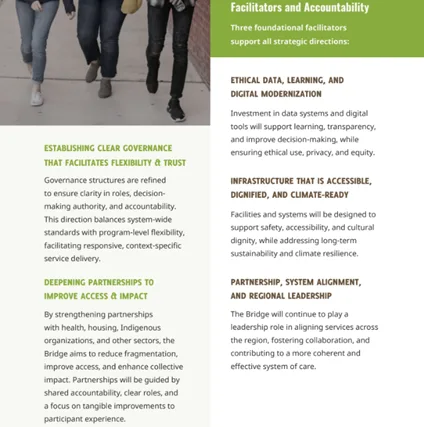
For The Bridge Youth & Family Services in Kelowna, we conducted more than 30 interviews across six stakeholder groups: the board, leadership, staff, youth, adults and early years. We used AI-assisted qualitative coding to analyze what we heard systematically, and the resulting 2026 to 2030 plan sets out five strategic directions, an enabling framework, phased implementation and a monitoring approach.
The number of interviews matters less than covering each group whose experience the plan will change, and showing them afterwards where their input went.
Make real choices
A usable plan has a small number of strategic directions, typically three to five, and each one implies something the organization will do less of, or stop. Before finalizing, test each direction against three questions:
- What will we stop or deprioritize to make room for this?
- Do we have, or can we realistically get, the staff and funding to do it?
- How will we know, in one to three years, that it is happening?
A direction that can’t answer all three is an aspiration, not a strategy. Aspirations belong in a vision statement.
Build implementation in, not on afterwards
The implementation section is where most plans are thinnest. It should cover each of these:
| Plan element | What it should include |
|---|---|
| Strategic direction | The change you want, why it matters, and the evidence behind it |
| Objectives | What will be different in one to three years, in terms you can measure |
| Actions | Specific initiatives, each with a named owner |
| Phasing | What happens in year one and what waits, given real capacity |
| Resources | Staff time, budget and where the funding is expected to come from |
| Enabling framework | The governance, people, data and funding systems the directions depend on |
| Indicators | A small set of measures for each direction |
| Review rhythm | When leadership and the board review progress, and how the plan is adjusted |
Keep it alive after approval
- Tie it to the budget. The annual operating plan and budget should map to the strategic directions. If a direction gets no resources, the plan has quietly changed.
- Review it quarterly. Leadership reviews progress against the indicators; the board sees a short summary, not a long activity report. A simple dashboard helps.
- Align funding with it. Use the plan as the fit test for every grant opportunity, so funding pulls in the same direction. Our go/no-go test for grants builds this in.
- Refresh it annually. Adjust actions and phasing each year; keep the directions stable unless something fundamental changes.
- Close the loop with stakeholders. Tell staff, clients and partners what changed because of what they said. It builds the trust you will need for the next plan.
Questions to ask a strategic planning consultant
- What evidence will the plan be built on?
- Listen for an environmental scan, your own organizational data and systematic stakeholder research, not workshops alone.
- Who will you hear from, and how will you analyze it?
- A good answer names the stakeholder groups, the methods for each, and how responses will be analyzed rather than summarized from notes.
- How will we see where each direction came from?
- You should be able to trace every strategic direction back to the evidence and the voices behind it.
- What does the implementation plan include?
- Actions with owners, phasing, resources and indicators, not just a list of directions.
- How will we track progress?
- Look for a small set of indicators and a review rhythm your team can realistically keep up.
- What will our team need to contribute?
- Expect to provide data, access to stakeholders, decision-makers at key points and time to review drafts. A clear answer protects everyone’s schedule.
Common questions
How many years should a nonprofit strategic plan cover?
Three to five years is common. Longer plans need stable directions with an annual refresh of actions and phasing; shorter ones suit organizations going through rapid change.
How long does the planning process take?
It depends on the size of the organization and how many stakeholder groups are involved. Agree the timeline in the scope, and allow time for drafts to be reviewed properly.
Do we need an external consultant?
Not always. An external team adds independence, research capacity and a neutral way to synthesize views that people may not share openly with leadership. Smaller organizations sometimes bring in outside help for the research and synthesis, and facilitate the decisions themselves.
How many stakeholders should we involve?
Enough to hear from each group whose experience the plan will change. Coverage across groups matters more than the total number of interviews or survey responses.
What is the difference between a strategic plan and an operational plan?
The strategic plan sets direction and priorities over several years. The operational plan sets out this year’s actions, budget and responsibilities to move those priorities forward. Both are needed, and they should map to each other.
Should funders be involved in our strategic plan?
Their perspective can be valuable, and some will want to know your direction. But the plan should be yours. A plan shaped around one funder’s priorities is fragile when that funding changes.
The short answer
Strategic plans stall when they aren’t connected to everyday decisions about budget, staffing, programs and funding. Build the plan from evidence and real stakeholder input, choose a few directions with genuine trade-offs, give each one owners, resources and indicators, and review progress regularly so the plan keeps guiding decisions.
Geo-Lens is a Calgary-based research, evaluation and funding consultancy working with nonprofits, charities, health organizations and research teams across Canada. Our strategic planning work combines environmental scans, community data and multi-group stakeholder research with facilitation, and every plan includes an implementation roadmap and monitoring approach. Because each direction can be traced back to evidence, the plan is easier to explain to staff, and easier to fund.