Quick answer
A case for support explains why your organization’s work matters, what you will do and why a funder should invest. A well-built strategic plan already holds most of it: the need and the evidence behind it, the change you are committed to, your priorities, and how you will measure progress.
Treat the plan as the source and the case for support as its funder-facing version. Write the core case once from the plan, adapt it for each funder, and use the plan to decide which opportunities to pursue. When a funder’s priorities don’t match the plan, that is a signal to decline or negotiate, not to rewrite your strategy one application at a time.
The problem with telling two stories
When the strategic plan and the case for support are written separately, they drift apart. The plan says the organization is focusing on three directions; this year’s applications describe five different priorities, each shaped to a funder. Staff rewrite the need statement for every deadline. The board approves a plan that the funding never quite supports.
Funders notice too. A foundation that reads your applications over several years can see when priorities shift with each call for proposals. And because funding is one of the strongest forces on what an organization actually does, a gap between the plan and the applications usually ends with the applications winning. That is one of the main reasons strategic plans end up on the shelf.
What a case for support contains, and where it comes from
Almost every element of a strong case for support has a natural source in a well-built strategic plan:
| Case for support element | Where it comes from in a strong plan |
|---|---|
| The need | The environmental scan and community data |
| Who you serve, and where | Organizational data and place-based analysis |
| What you do and why it works | Program logic models and the theory of change |
| Where you are going | Strategic directions and objectives |
| What will change | Outcomes and the indicators that track them |
| Why your organization | Track record, partnerships and stakeholder voice |
| What it will take | The implementation roadmap and resource plan |
If your plan can’t supply one of these, the gap is in the plan, not just in the case. A plan without evidence of need, measurable outcomes or a resource picture will struggle to guide decisions as well as to persuade funders.
Write the core case once
- Start from the strategic directions. Each direction becomes a funding story: the need it responds to, the change you want, your approach and how you will measure it.
- Lift the evidence from the plan. Reuse the environmental scan and stakeholder findings, with their sources, and refresh figures when newer data is published, so nobody re-researches the same statistics before each deadline.
- Bring in the voices. Stakeholder research gives you what clients, staff and partners said in their own words. Use it with the consent it was gathered under.
- Attach the program logic. A logic model for each program shows funders how activities lead to the outcomes in the plan.
- Keep it modular. Write the sections funders most often ask for (need, approach, outcomes, organizational capacity and sustainability) at a few standard lengths, so they can be fitted to any template.
- Keep it yours. Hold the master version in your own systems, in a format your team can edit, so it survives changes in staff and writers.
Adapt it for each funder; don’t rewrite it
Some things should change from one application to the next, and some shouldn’t:
| Adapt for each funder | Keep the same |
|---|---|
| The funder’s own language and priorities | The need and the evidence behind it |
| Which program, population or region you emphasize | Your strategic directions |
| Length, format and section order | The outcomes you commit to |
| The specific budget and workplan | How you measure progress |
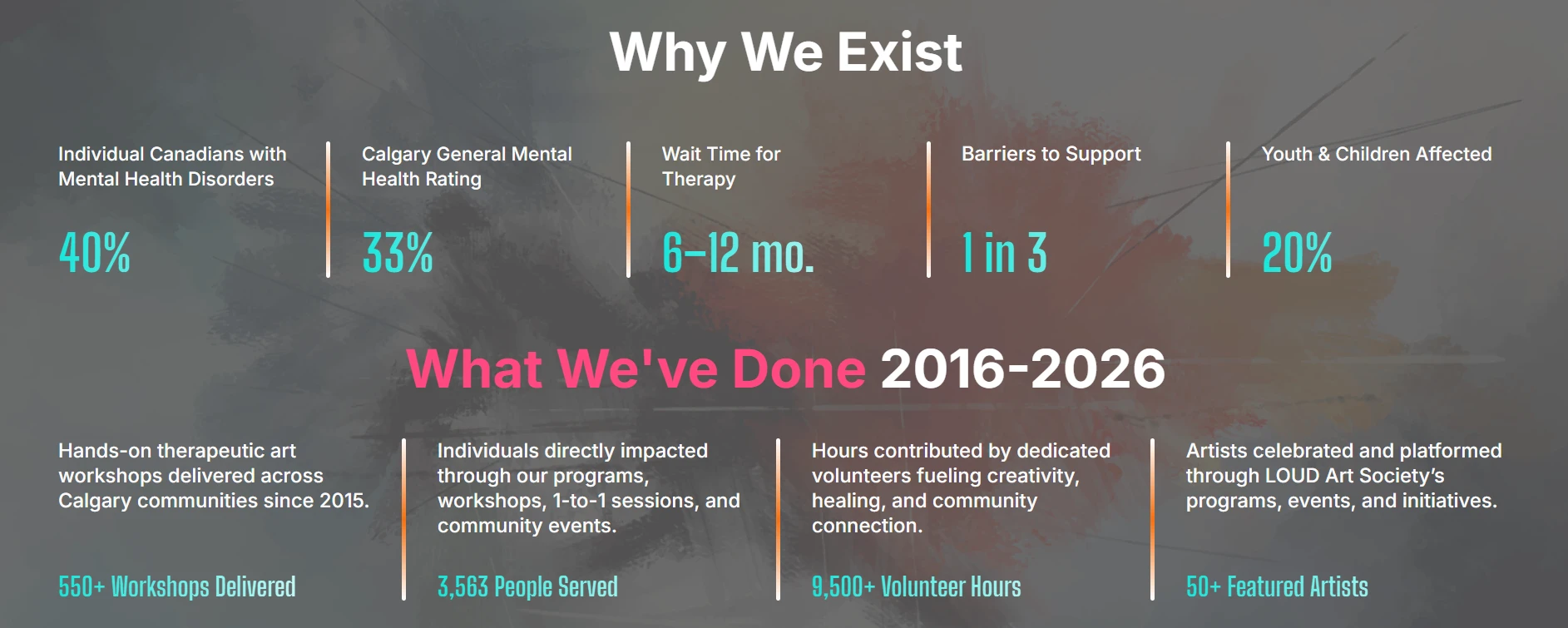
This is how one organization can work with very different funders without changing direction for each of them. For LOUD Art Society, a business plan for 2026 to 2029 anchors a funding portfolio built over four years across ten funders in arts, health and community streams. Arts, health and community funders look for different things; a shared plan underneath lets each application speak to its funder while the organization’s direction stays the same.
When a funder’s priorities don’t match your plan
It will happen. A funder announces a new stream that is close to your work, but not quite. You have a few honest options:
- Decline. If the overlap is thin, saying no protects your strategy and your team’s time. A go/no-go test makes this a routine decision rather than a debate.
- Find the genuine overlap. Often one direction in your plan fits part of the funder’s priorities. Apply for that part, described in your terms and theirs.
- Talk to the program officer. Ask whether a project within your plan would be considered. The answer is often more flexible than the guidelines suggest.
- Revisit the plan deliberately. If a funding shift reveals a real opportunity, take it to leadership and the board as a strategic question. Don’t let a single application change your strategy by default.
Why evidence-based plans make stronger cases
Reviewers look for evidence of need, the voice of the community, a credible approach and measurable outcomes. A plan built from community data and systematic stakeholder research already contains all four, and every direction can be traced back to its source.
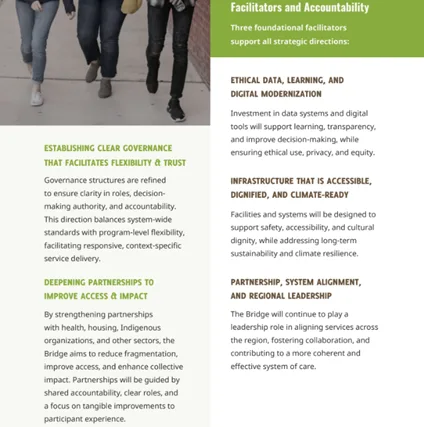
The plan we built with The Bridge Youth & Family Services is an example of the raw material this produces: more than 30 interviews across six stakeholder groups, analyzed with AI-assisted qualitative coding, leading to five strategic directions with an enabling framework, phased implementation and a monitoring approach. That is a strategic plan and a documented evidence base at the same time.
Keeping funding and strategy aligned over time
- Use the plan as the fit test. Every opportunity is assessed against the plan before anyone starts writing.
- Track funding by direction. Map your grant calendar and funding pipeline to the plan’s directions, so you can see which ones are under-resourced. This is a core part of a funding strategy.
- Feed reports back into the plan. Funder reports are evidence of progress. Draw them from the same indicators the plan uses.
- Refresh the case with the plan. When the plan is reviewed each year, update the core case with new data, outcomes and stories.
- Show the board the pipeline by direction. It turns funding from an operational detail into a strategic conversation.
Is your plan ready to be a case for support?
- Does each strategic direction state the need it responds to, with evidence?
- Does each direction have outcomes and indicators?
- Does the plan say what each direction will need in staff and funding?
- Can you trace the directions back to stakeholder input?
- Is it written in plain language you would be comfortable using with a funder?
- Does it describe your track record and partnerships?
If more than two of these are a no, strengthening the plan will do more for your funding than writing more applications.
Common questions
What is the difference between a case for support and a grant application?
A case for support is your core, reusable argument for why your work matters and deserves investment. A grant application adapts that argument to one funder’s questions, format and priorities.
Should we share our strategic plan with funders?
Often, yes. Some funders ask for it, and even when they don’t, a short public summary of the plan shows that an application is part of a deliberate strategy rather than a response to whatever is open.
What if we don’t have a current strategic plan?
Build an interim case from your current priorities, program data and program logic, and plan to renew the strategic plan soon. The case will be stronger, and easier to maintain, once the plan exists.
Who should write the case for support?
Usually the development lead or grant writer, working closely with the executive director and program leads, and drawing directly on the strategic plan and its evidence.
How often should the case for support be updated?
At least once a year, when the strategic plan is reviewed, and whenever significant new evidence, outcome data or program changes arrive.
Is a case for support only for grants?
No. The same core case supports donor appeals, sponsorship, government proposals and partnership conversations, each adapted to its audience.
The short answer
A strong strategic plan already contains most of your case for support: the need, the evidence, the directions and the outcomes. Write the core case once from the plan, adapt it for each funder without changing the substance, and use the plan to decide which opportunities to pursue. That keeps your funding and your strategy pulling in the same direction.
Geo-Lens is a Calgary-based research, evaluation and funding consultancy working with nonprofits, charities, health organizations and research teams across Canada. Our strategic planning work builds plans from community data and multi-group stakeholder research, and our grant writing and funding strategy work draws on that same evidence. Because both sit in one practice, the plan and the case for support are built to work together from the start.