Quick answer
A community needs assessment identifies the gaps between what a community or population needs and what currently exists, so organizations can decide where to act. A credible one combines public data such as the census, local service and program data, and what community members and service providers say, and it maps need below the community-wide average.
Start with the decisions the assessment will inform, define the geography and population precisely, use more than one kind of evidence, involve the people affected, and finish with clear priorities rather than a list of every need you found.
What a community needs assessment is, and isn’t
A needs assessment compares what a community or population needs with the services, resources and conditions that exist, and identifies the gaps that matter most. Good ones also map strengths: the organizations, networks and assets a response can build on.
It isn’t a wish list, a single survey or a program evaluation. An evaluation judges how a particular program is doing; a needs assessment looks at the community, and often comes before a program exists. See what a program evaluation delivers for the difference.
Start with the decision it will inform
The most useful assessments are designed backwards from a decision: where to open a new site, which population to prioritize, what to put in a strategic plan, or how to make the case for a funding application. The decision determines the questions, the geography, the data you need and how deep to go. An assessment without a decision tends to grow until it describes everything and decides nothing.
Housing is a special case. Many municipalities now have legislated housing needs assessments with prescribed content; see why housing needs assessments go out of date.
Define the community precisely
- Geography. A municipality, specific neighbourhoods, a service catchment or a region. Where possible, build it from standard census geographies so you can use public data consistently.
- Population. Everyone in the area, or a specific group such as youth, seniors, newcomers or people with a disability.
- Time. The period the evidence describes, and how current it needs to be for the decision.
Use the data that already exists
Much of what you need is already published. Start there before designing new data collection:
| Source | What it tells you | Watch for |
|---|---|---|
| Census of Population | Demographics, income, housing, language and households, down to small areas | A five-year snapshot; 2026 Census results are released through 2027 |
| Canadian Index of Multiple Deprivation | Area-level deprivation across four dimensions, for small areas | A relative measure, currently based on 2021 Census data |
| Point-in-Time counts and service data | Homelessness and patterns of service use | Tends to miss hidden homelessness; methods vary between communities |
| Your own and partners’ program data | Who is actually being served, and how | Definitions differ between organizations |
| Health and social surveys | Health status, behaviours and access to care | Small samples at the local level |
| Municipal open data | Services, facilities, transit and land use | Coverage varies between municipalities |
Statistics Canada’s Canadian Index of Multiple Deprivation is particularly useful: it measures deprivation for dissemination areas, the smallest standard geography for which all census data is released, which makes it possible to compare neighbourhoods rather than whole cities.
Hear from the people affected
Data shows where need is concentrated; people explain what it is like, what gets in the way and what would help. Plan engagement as carefully as the data work:
- Reach beyond current service users. The people a service already reaches are the easiest to hear from, and the least likely to reveal who is missing.
- Mix methods: surveys for breadth, interviews and focus groups for depth, and community conversations for priorities.
- Include service providers and partners, who see patterns across many people.
- Make participation accessible, in language, format, location and timing, and compensate people with lived experience for their time.
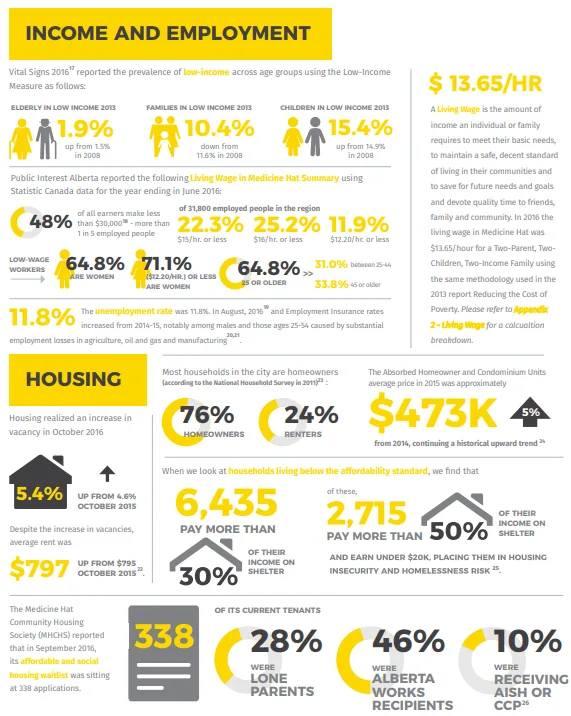
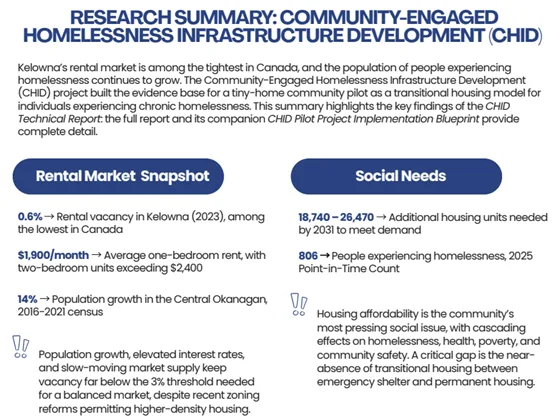
For THRIVE, Medicine Hat’s poverty reduction strategy, a 338-participant community engagement survey was synthesized with census, low-income and health data. For the evidence base behind Kelowna’s first tiny home community, a rental market assessment, social needs assessment and policy gap analysis were combined with 31 interviews, 3 focus groups and more than 40 interest-holder consultations.
Map need below the average
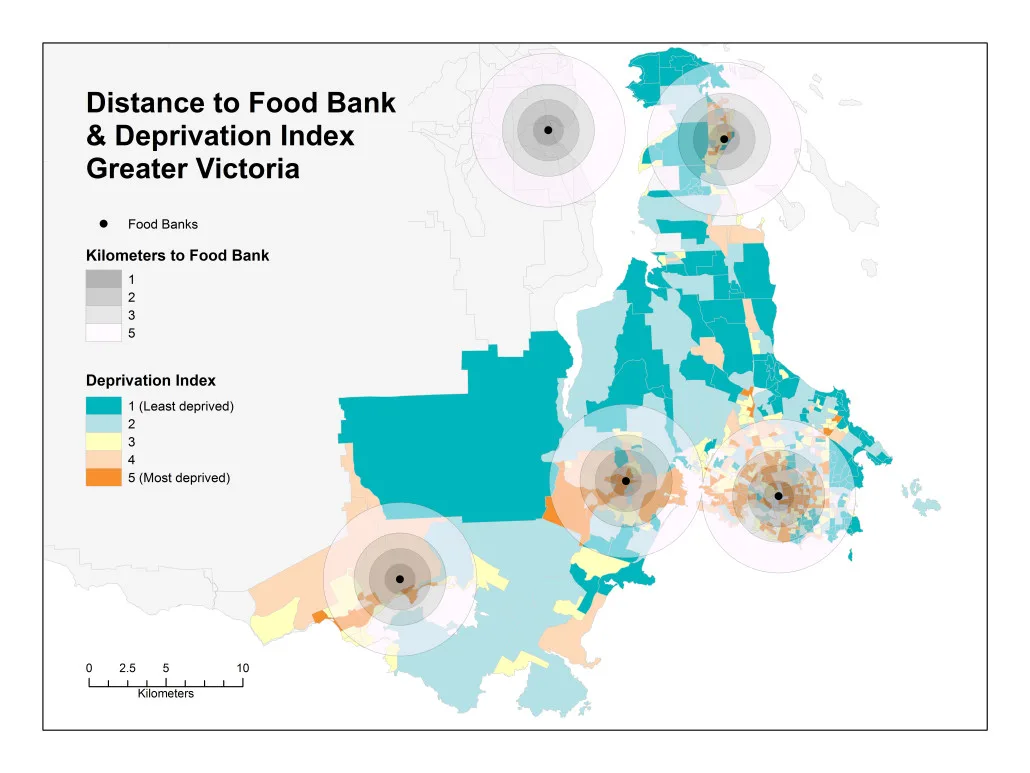
Community-wide averages hide the neighbourhoods where need concentrates. Mapping need at the census tract or dissemination area level, and overlaying the locations of services, shows where gaps actually are. In Greater Victoria, mapping food bank locations against neighbourhood deprivation showed where access barriers may overlap with higher material deprivation. See why place matters for the methods.
Turn findings into priorities
An assessment that lists every need hands the hardest decision back to the reader. Bring the evidence together, then rank needs against agreed criteria:
- Size: how many people are affected.
- Severity: how serious the consequences are.
- Equity: whether some groups or areas are disproportionately affected.
- Gaps: whether existing services already meet the need.
- Community priority: what the people affected said matters most.
- Fit: whether your organization, or a partner, is well placed to respond.
Where the numbers and the voices disagree, say so. That tension is often the most useful finding.
Report it so it gets used
- Lead with a short summary and the priority list. Put methods and full tables in an appendix.
- Use maps. They communicate place-based findings faster than any table.
- Share it back with the community that contributed, in an accessible format.
- Make the data reusable, for funding applications, partners and future updates, rather than locking it in a PDF.
- Plan the refresh. Decide which indicators you will update, and when, including after the 2027 census releases.
Common mistakes
- Running a new survey for questions public data already answers.
- Reporting only community-wide averages.
- Hearing only from people already being served.
- Ending with a long list of needs and no priorities.
- Ignoring strengths and assets that a response could build on.
- No plan to update it, so it is out of date by the time anyone acts on it.
Common questions
How long does a community needs assessment take?
It depends on the geography, the population and how much new data collection and engagement is needed. Agree the scope and timeline in writing before work begins, working back from the decision the assessment needs to inform.
How often should it be updated?
Major updates usually follow new census releases and planning cycles. In between, a light annual refresh of local service and program data keeps it useful.
Can a small nonprofit do one?
Yes, at the right scale. Public data plus focused engagement with the people you serve, and those you don’t yet reach, can produce a credible assessment without a large budget.
What is the difference between a community needs assessment and a housing needs assessment?
A housing needs assessment focuses on housing and, for many municipalities, follows a legislated template. A community needs assessment can cover any area of need and is shaped by the decisions it informs.
Do we need ethics approval?
Organizational needs assessments generally aren’t subject to formal research ethics review, unless they are run through a university or as research. Either way, follow ethical practice: informed consent, privacy protection, accessible participation and fair compensation for lived experience.
What is asset mapping?
Identifying a community’s strengths, such as organizations, networks, skills, spaces and relationships, alongside its needs. It shows what a response can build on and avoids framing a community only by its problems.
The short answer
A community needs assessment funders will trust starts from the decision it will inform, defines its geography and population precisely, combines public data with local service data and community voices, maps need below the average, and ends with clear priorities. Plan how it will be shared, reused and refreshed.
Geo-Lens is a Calgary-based research, evaluation and funding consultancy working with nonprofits, charities, health organizations, municipalities and research teams across Canada. Our research and evidence work includes community and population needs assessments that combine census and administrative data with community engagement and place-based analysis, built to inform plans, programs and funding applications.